Jewish Sects of the Second Temple Period
The emergence of Jewish sects is one of the defining characteristics of the Second Temple period. Unlike the earlier biblical era, where Israel is largely presented as a unified people, this later period is marked by internal division, debate, and competing visions of identity.
Notably, the Tanakh (Old Testament) contains no clear references to formal Jewish sects. Their development is the result of historical, theological, and cultural shifts that unfolded over several centuries.
The Perspective of Deuteronomy
In Deuteronomy, a clear call for separation is established between Israel and the surrounding nations:
“For you are a holy people to the Lord your God: the Lord your God has chosen you to be a people for Himself, a special treasure above all the peoples on the face of the earth.”
Deuteronomy 7:6
This separation is rooted primarily in the danger of idolatry:
“For they will turn your sons away from following Me, to serve other gods; so the anger of the Lord will be aroused against you and destroy you suddenly.”
Deuteronomy 7:4
Here, Israel’s distinct identity is framed in covenantal and religious terms. The concern is not ethnicity in itself, but faithfulness to God.
Ezra’s Viewpoint (5th Century BC)
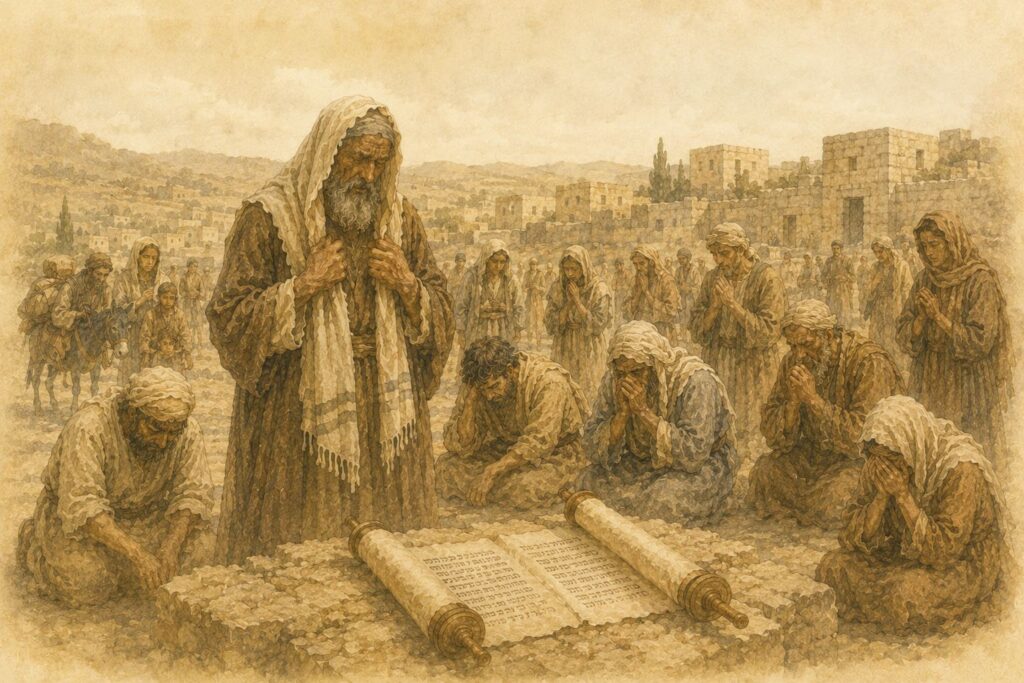
A significant development appears in the book of Ezra. Following the return from the Babylonian exile, intermarriage with surrounding peoples is presented not merely as a social issue, but as a profound act of covenantal unfaithfulness.
“After all these things had been done, the officials approached me and said, ‘The people of Israel and the priests and the Levites have not separated themselves from the peoples of the lands with their abominations, from the Canaanites, the Hittites, the Perizzites, the Jebusites, the Ammonites, the Moabites, the Egyptians, the Amorites. For they have taken some of their daughters to be wives for themselves and for their sons so that the holy seed has mixed itself with the peoples of the lands. And in this faithlessness, the hand of the officials and chief men has been foremost.’
Ezra 9:1-6
As soon as I heard this, I tore my garment and my cloak and pulled hair from my head and beard and sat appalled. Then all who trembled at the words of the God of Israel, because of the faithlessness of the returned exiles, gathered around me while I sat appalled until the evening sacrifice. And at the evening sacrifice, I rose from my fasting, with my garment and my cloak torn, and fell upon my knees and spread out my hands to the Lord my God, saying:
‘O my God, I am ashamed and blush to lift my face to you, my God, for our iniquities have risen higher than our heads, and our guilt has mounted up to the heavens.'”
This passage highlights not only the issue itself, but the depth of Ezra’s response – mourning, public grief, and confession. Intermarriage is framed here as a violation of Israel’s distinct identity and covenantal calling.
In priestly law (especially in Leviticus), strict regulations governed lineage and purity within the priesthood. Certain unions could disqualify descendants from serving as priests. In Ezra, a similar concern for purity appears to extend beyond the priesthood to the wider population.
During the transition from the First Temple period to the Second Temple period, a new perception appears to emerge – likely within priestly circles. What had once been a concern specific to the priesthood now begins to be applied to the entire nation.
This development is significant. It reflects a shift from a differentiated structure within Israel to a more unified standard of identity, in which the boundaries that once defined the priesthood begin to shape the people as a whole.
Although this approach was not universally accepted, it seems to reflect a broader process that began during the Babylonian exile: an effort to preserve Israel’s identity in the face of dispersion and external influence.
From Exile to Separation
Another layer of separation emerges in the post-exilic period. The returning exiles begin to distinguish themselves not only from foreign nations, but also from other inhabitants of the land:
“When the enemies of Judah and Benjamin heard that the exiles were building a temple for the Lord, the god of Israel, they came to Zerubbabel and to the heads of the families and said, ‘Let us help you build because, like you, we seek your God and have been sacrificing to him since the time of Esarhaddon king of Assyria, who brought us here.’
Ezra 4:1-3
But Zerubbabel, Joshua and the rest of the heads of the families of Israel answered, ‘You have no part with us in building a temple to our god. We alone will build it for the lord, the God of Israel, as King Cyrus, the king of Persia, commanded us.'”
The group that returned from exile did not permit the local inhabitants to participate in rebuilding the Second Temple. Although these groups claimed to worship the same God, they were not recognized as part of Israel.
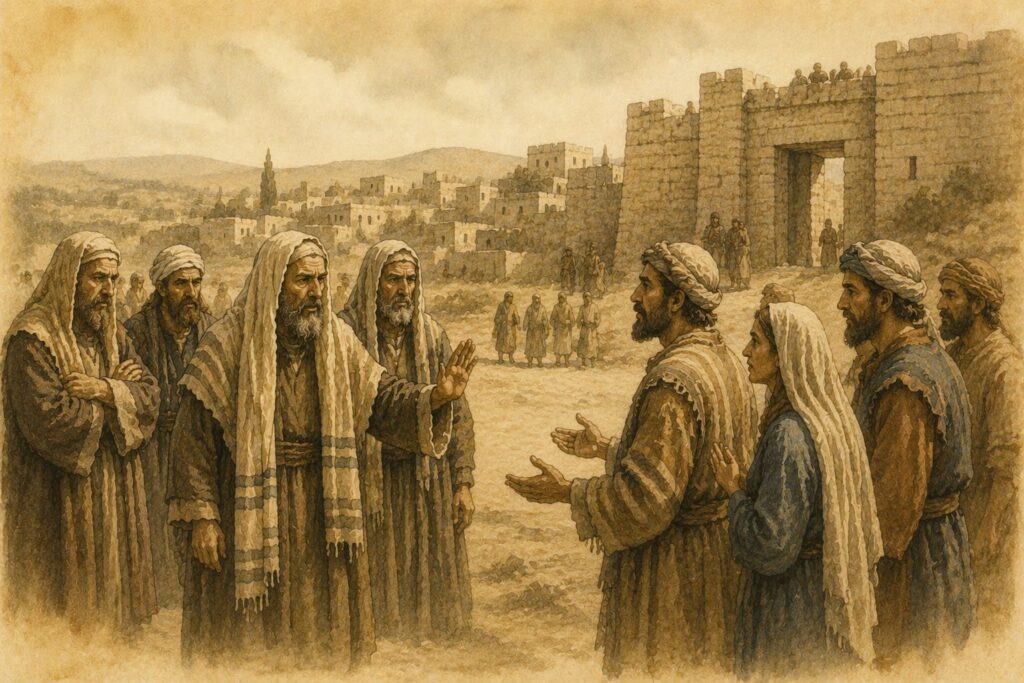
The returning exiles appear to have viewed these inhabitants as outsiders – at times even as rivals or adversaries.
Note: The populations living in the region of Samaria were not regarded as part of Israel, but as outsiders. Historically, however, there is evidence of interaction and intermixing between remnants of the northern tribes and other peoples. Over time, this population came to be identified with what is later known as the Samaritan community.
In this context, the returning exiles asserted that they alone constituted the true Israel, and that the Temple belonged exclusively to them.
While this does not yet represent sectarianism in the formal sociological sense, it reflects a critical stage in its development: the drawing of boundaries, the exclusion of others, and the definition of identity in increasingly exclusive terms.
This raises a broader question that would continue to shape Jewish thought in the centuries that followed:
What place, if any, do outsiders have within the people of Israel?
Gentiles and the Question of Inclusion
The question of how Israel should relate to the Gentiles – those outside of the covenant – became increasingly central during this period.
Different biblical voices reflect different perspectives on this question.
The prophet Ezekiel emphasizes restriction and boundary, particularly regarding access to the Temple (Ezekiel 44:1-17). His vision carefully distinguishes between those who may enter and those who may not, explicitly excluding foreigners. The fact that this issue is addressed so directly suggests that it was already a matter of debate.
In contrast, the prophet Isaiah presents a more inclusive vision:
“Thus says the Lord: ‘Keep justice, and do righteousness, for soon my salvation will come, and my righteousness be revealed. Blessed is the man who does this, and the son of man who holds it fast, who keeps the Sabbath, not profaning it, and keeps his hand from doing any evil.’
Isaiah 56:1-6
Let not the foreigner who has joined himself to the Lord say, ‘The Lord will surely separate me from his people’; and let not the eunuch say, ‘Behold, I am a dry tree.’ For thus says the Lord: ‘To the eunuchs who keep my Sabbaths, who choose the things that please me and hold fast my covenant, I will give in my house and within my walls a monument and a name better than sons and daughters; I will give them an everlasting name that shall not be cut off.’
And the foreigners who join themselves to the Lord, to minister to him, to love the name of the Lord, and to be his servants, everyone who keep the Sabbath and does not profane it, and holds fast my covenant –”
Isaiah envisions a future in which Gentiles who commit themselves to God are not excluded, but welcome into covenantal life.
His words suggest a process through which those from the nations could draw closer to Israel – not by ancestry, but through the commitment to God and His covenant.
Note: From the time of the Babylonian exile and onward, Jewish communities increasingly lived among the nations. In this context, non-Israelites appear to have shown interest in the God of Israel and in joining themselves, in some form, to His people. At this stage, however, the formalized process of conversion to Judaism, as it would later develop, had not yet fully taken shape.
A Growing Tension in the Persian Era
The contrast between Ezekiel’s more exclusionary stance and Isaiah’s more inclusive vision reflects a broader tension that appears to have taken shape during the Persian period.
In the generations following the return from Babylon, the question of identity became increasingly complex. As communities were rebuilt and redefined, differing views emerged regarding the boundaries of Israel and the place of outsiders within it.
This tension can be summarized in a central question:
Should Israel remain distinct and separate, or open itself to those from the nations who seek to join?
It is possible that the developments reflected in the books of Ezra and Nehemiah are not isolated reactions, but expressions of this deeper and ongoing debate – one that predates the encounter with the Hellenistic culture and continues to shape the emergence of sectarianism.
The Hellenistic World and the Rise of Identity Pressure
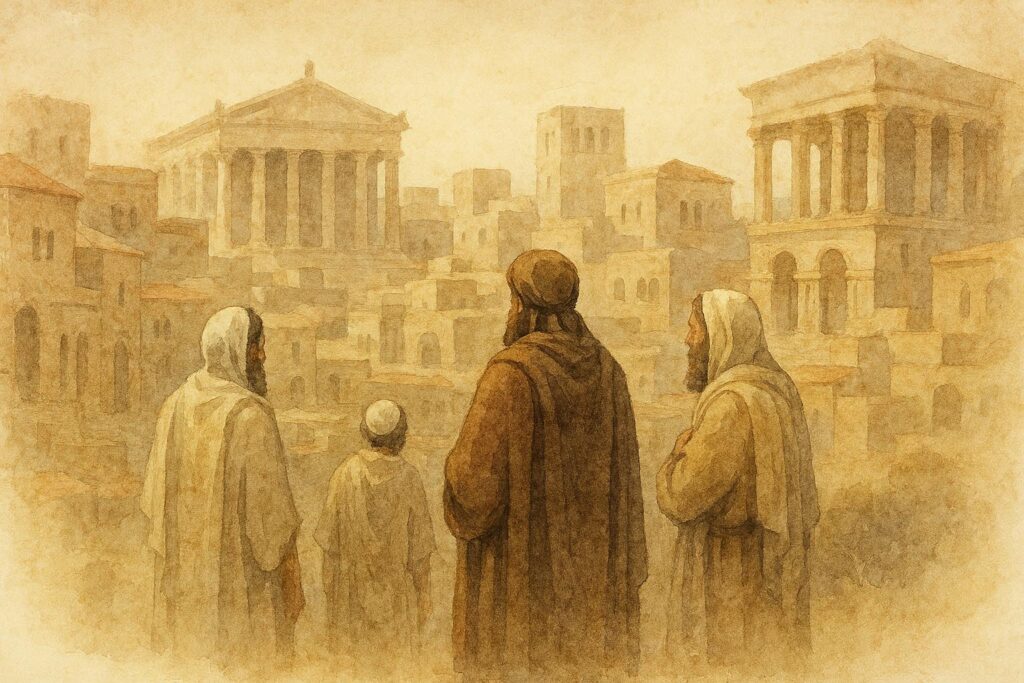
The encounter between the Jewish and Hellenistic worlds played a major role in the development of sectarianism. From 332 BC onward, Hellenism introduced not only Greek political influence, but an entirely new cultural framework that reshaped the East.
In the traditional Old World order, identity was understood primarily in terms of land and ancestry. A person belonged to a people through birth, family lineage, and territorial connection. These were the stable markers of identity in the Near Eastern world.
The Greek thinker Socrates, however, articulated a different vision. He argued that being “Greek” was not determined by ethnicity, but by participation in Greek education and culture. According to this view, whoever adopted the Greek language, philosophy, and way of life could be considered Greek, regardless of their place of origin.
This represented a significant shift away from the assumptions of the Old World order. Identity was no longer fixed solely by birth and land, but could now be shaped through culture, education, and intellectual formation.
The Hellenistic world also introduced a highly developed urban culture. Large cities became centers of shared life, featuring planned streets and public spaces, advanced infrastructure, markets, temples, and cultural institutions. Across the Hellenistic realm, people encountered the same literature, participated in similar forms of education, and were exposed to shared artistic and theatrical traditions. Performers and teachers moved between cities, contributing to a broadly unified cultural environment.
In this context, culture itself became increasingly standardized. A person in Egypt, Asia Minor, or Judea might be exposed to the same texts, ideas, and styles of education.
This raises a central question:
In a global culture where everyone reads the same books, listens to the same music, and follows the same customs, what defines a person’s national identity?
For the Jewish world, this question became especially significant during the Second Temple period. The traditional markers of identity rooted in the Old World order – land, ancestry, and covenantal distinction – were now being challenged by a broader cultural system that transcended geography.
Judea
From the return from exile at the end of the 6th century BC until the Hasmonean period (mid-2nd century BC), Judea remained a relatively small region within the broader territory of Israel. Much of the land that had once belonged to Israel was now inhabited by Gentile populations. The largest concentration of Jews was in Judea, while beyond it lay a network of Hellenistic cities and cultures that exerted increasing social and cultural pressure on the Jewish population.
It is therefore not surprising that the formation of Jewish sects reached its peak during the Hasmonean period, particularly as the Hasmonean dynasty expanded its political and territorial influence. The Hasmonean rulers occupied an in-between position: neither fully Hellenistic nor entirely aligned with older Israelite models, they attempted to integrate elements of both worlds.
This tension is visible in their material culture. Their coinage combined Jewish symbols – such as the Menorah and ancient Hebrew script – with Hellenistic imagery. This is also reflected in the tombs of elite officials, which reflect clear Hellenistic influence in style and form – even among priestly circles.
On one hand, the Hasmoneans maintained a connection to Israel’s heritage; on the other, they adopted and operated within the wider Hellenistic cultural world. This fusion created significant internal tension within Jewish society, particularly regarding identity and covenantal boundaries.
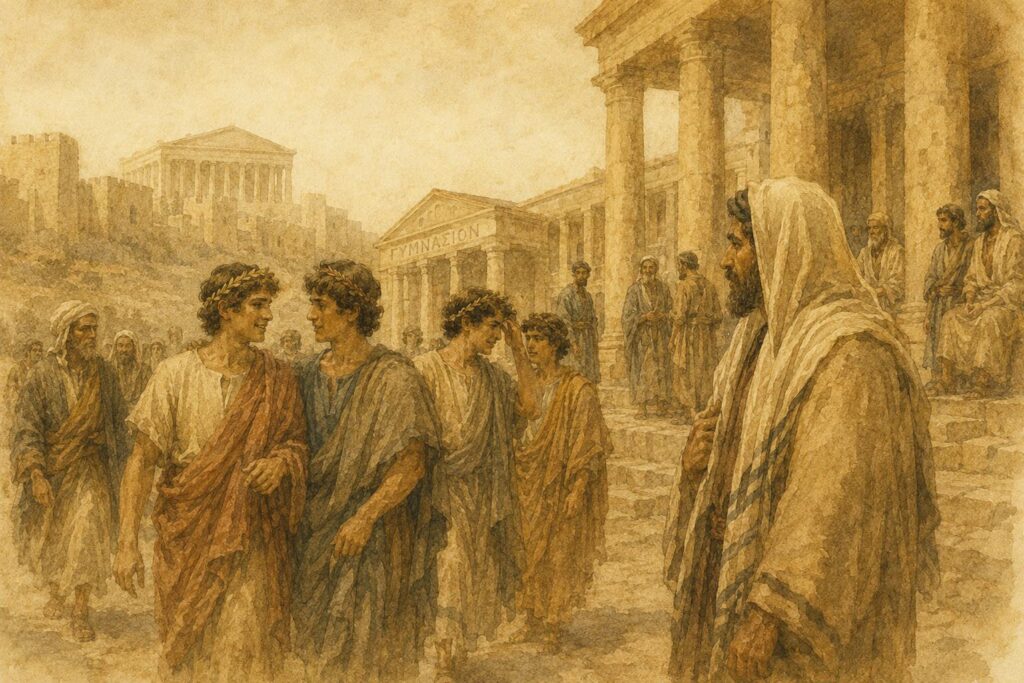
This tension is reflected in 1 Maccabees:
“In those days, certain renegades came out from Israel and misled many, saying, ‘Let us go and make a covenant with the Gentiles around us, for since we separated from them, many disasters have come upon us.’ This proposal pleased them, and some of the people eagerly went to the king, who authorized them to observe the customs of the Gentiles. They built a gymnasium in Jerusalem, according to the Gentile custom, and removed the marks of circumcision and abandoned the holy covenant. They allied themselves with the nations and sold themselves to do evil.”
1 Maccabees 1:11-15
The author of the Book of Jubilees, an ancient Jewish apocryphal text, was likely a priest engaged in polemics against the more compromising priests serving in Jerusalem at the time. Although framed as a revelation given to Moses on Mount Sinai, its content clearly engages with contemporary debates about identity, covenant, and separation.
“For the Lord did not make this covenant with all people, but only with Abraham and his descendants. That is why He commanded the children of Israel to keep it as an everlasting sign, so that they would not be like the nations and would remain set apart for Him. He gave them the command to circumcise their sons on the eighth day, so that they would bear His mark in their flesh as a sign of the covenant. This law is not to be removed or altered forever. Anyone who rejects this commandment has broken the covenant and defiled the sign of belonging to the Lord.”
Jubilees 15:39-42
Together, these texts suggest that some Jews were abandoning or concealing markers of identity, including circumcision, under external cultural pressure. The result was a profound identity crisis.
At its core, the dilemma of the period can be expressed in simple terms:
How can identity be preserved?
Should it be concealed or suppressed?
Or should it be strengthened and defended?
The emergence of Jewish sects can be understood as different responses to these pressing questions.
Josephus Flavius and the Jewish Sects
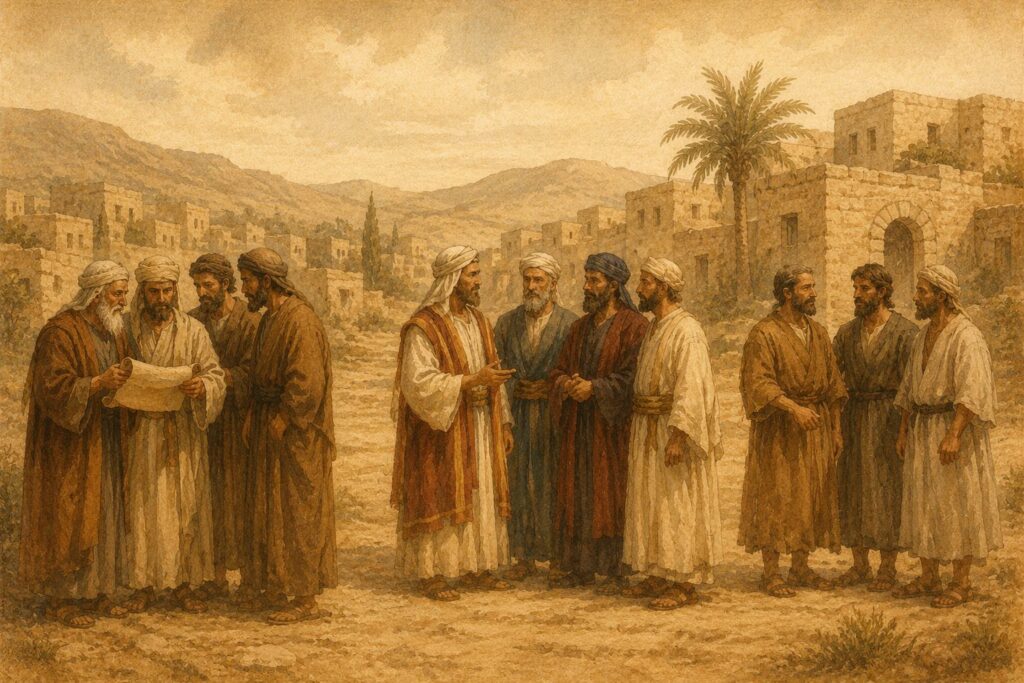
It is therefore not surprising that, during the Hasmonean era, the Jewish historian Josephus Flavius describes the existence of distinct Jewish sects in Israel.
In his work, Antiquities of the Jews, he identifies three primary groups:
“At this time there were three sects among the Jews, who had different opinions concerning human actions; the one was called the sect of the Pharisees, another sect of the Sadducees, and the other sect of the Essenes. Now for the Pharisees, they say that some actions, but not all, are the work of fate, and some of them are in our own power, and that they are liable to fate, but are not caused by fate. But the sect of the Essenes affirm that fate governs all things, and that nothing befalls men but what is according to its determination.
Antiquities of the jews 13:171-173
And for the Sadducees, they take away fate, and say there is no such thing, and that the events of human affairs are not at its disposal; but they suppose that all our actions are in our own power, so that we ourselves are the causes of what is good, and receive what is evil from our own folly.”
Josephus’ account it especially valuable because it is not purely descriptive. In his autobiographical work, The Life of Flavius Josephus, he recounts his own personal exploration of these groups:
“And when I was about sixteen years old (A.D. 53), I had a mind to make trial of the several sects that were among us. These sects are three: the first is that of the Pharisees; the second that of the Sadducees; and the third that of the Essenes; as we have frequently told you. For I thought that by this means I might choose the best, if I were once acquainted with them all. So I contented myself with hard fare; and underwent great difficulties; and went through them all. Nor did I content myself with these trials only: but when I was informed that one whose name was Banus lived in the desert, and used no other clothing than grew upon trees; and had no other food that what grew of its own accord: and bathed himself in cold water frequently, both by night and by day, in order to preserve his chastity, I imitated him in those things; and continued with him three years (from A.D. 53 to A.D. 56).
Life of Flavius Josephus, chapter 2
So when I had accomplished my desires, I returned back to the city: being now nineteen years old: and began to conduct myself according to the rules of the sect of the Pharisees: which is of kin to the sect of the Stoicks, as the Greeks call them.”
Josephus’ background adds further weight to his testimony. He came from a prominent and aristocratic family, with priestly lineage and connections to the Hasmonean dynasty. As a member of the Jerusalem elite, he was uniquely positioned to observe and participate in the intellectual and religious life of his time.
The figure of Banus, whom Josephus encountered in the wilderness, is particularly intriguing. He is described as living an austere and disciplined life, devoted to purity and self-restraint. Although little is known about his origins, his lifestyle bears some resemblance to other wilderness figures of the period.
Like Banus, John the Baptist – who is described in the New Testament as coming from a priestly background – also lived in the wilderness and practiced a form of ascetic devotion. While there is no direct connection between the two, the comparison highlights the broader phenomenon of wilderness-based religious expression during this period.
Josephus himself, as a priest who actively explored multiple sects, represents the intellectual and spiritual searching that characterized the age. His account provides a valuable window into the diversity of Jewish thought during the Second Temple period and helps to explain how distinct sectarian identities emerged.
Josephus on the Pharisees
Josephus describes the Pharisees as one of the leading sects of the Second Temple period, known for their expertise in interpreting the law and their influence among the people:
“The Pharisees are those who are esteemed most skillful in the exact explication of their laws…These ascribe all to fate (or providence), and to God, and yet allow that to act what is right, or the contrary, is principally in the power of men, although fate does co-operate in every action.”
the War of the Jews 2:162
According to Josephus, the Pharisees held a nuanced understanding of divine providence and human responsibility. They affirmed that God is sovereign and involved in human affairs, yet also maintained that individuals retain genuine moral choice. Human actions are therefore neither purely determined nor entirely autonomous, but exist within a cooperative framework of divine providence and human responsibility.
This reflects an attempt to hold together two realities: divine governance and human freedom, without collapsing one into the other.
Importantly, Josephus’ language also reflects conceptual categories familiar within the wider Hellenistic-Roman world, where the idea of fate – often associated with the Moirai (the Fates) – described a reality in which both gods and humans were subject to an unchangeable destiny.
The Pharisees sought to reconcile this belief in fate with Jewish tradition, integrating elements from the surrounding cultural world while maintaining their distinct religious identity.
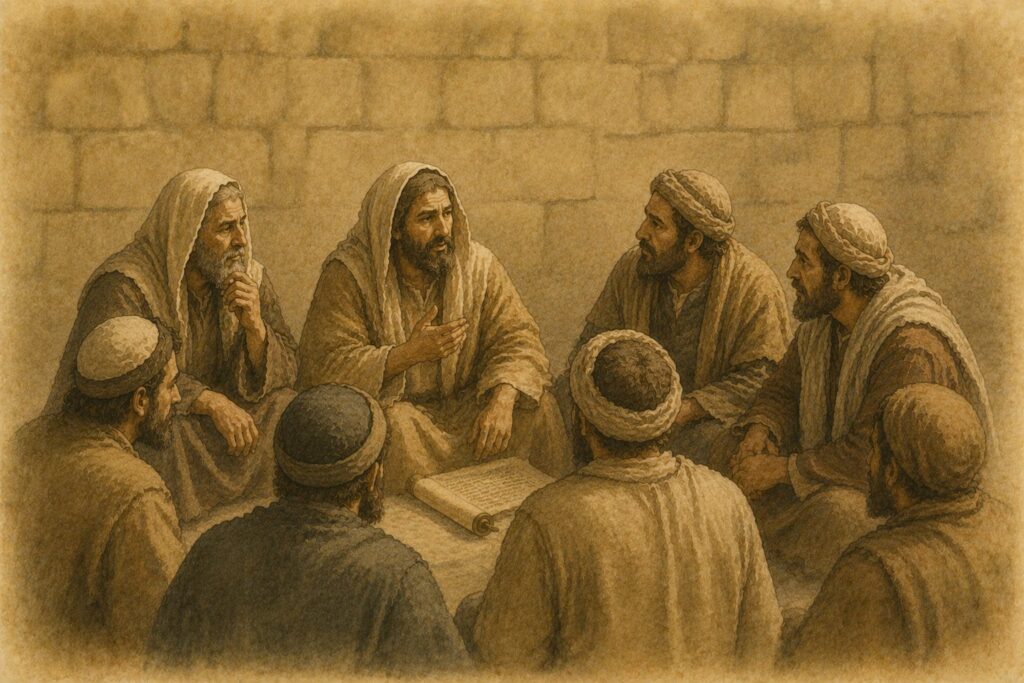
Josephus further elaborates on their way of life and beliefs:
“Now, for the Pharisees, they live meanly, and despise delicacies in diet; and they follow the conduct of reason; and what that prescribes to them as good for them they do; and they think they ought earnestly to strive to observe reason’s dictates for practice. They also pay a respect to such as are in years; nor are they so bold as to contradict them in anything which they have introduced.
Antiquities of the Jews 18:12-15
And when they determine that all things are done by fate, they do not take away the freedom from men of acting as they think fit; since their notion is, that it hath pleased God to make a temperament, whereby what he wills is done, but so that the will of man can act virtuously or viciously.
They also believe that souls have an immortal vigor in them, and that under the earth there will be rewards or punishments, according as they have lived virtuously or viciously in this life; and that the latter are to be detained in an everlasting prison, but that the former shall have power to revive and live again. On account of which doctrines they are able greatly to persuade the body of the people; and whatsoever they do about divine worship, prayer, and sacrifices, they perform them according to their direction; insomuch that the cities give great attestations to them on account of their virtuous conduct, both in the actions of their lives and their discourses also.”
Josephus presents the Pharisees as the most popular and socially influential of the Jewish sects. Their teachings shaped public religious life, and their interpretation of the law carried significant authority throughout Judea.
In this sense, the Pharisees can be understood as one response to the broader intellectual pressures of the Second Temple period. Rather than rejecting the surrounding cultural world or abandoning inherited tradition, they sought to preserve and interpret the Torah in a way that could coexist with the philosophical questions and cultural frameworks of their time.
Josephus on the Sadducees
Josephus describes the Sadducees as a distinct and more exclusive sect within Jewish society, characterized by their particular theological positions and their association with the social elite.
“But the doctrine of the Sadducees is this: That souls die with the bodies; nor do they regard the observation of anything besides what the law enjoins for them; for they think it an instance of virtue to dispute with those teachers of philosophy whom they frequent. But this doctrine is received but by a few, yet by those still of the greatest dignity. But they are able to do almost nothing of themselves; for when they become magistrates, as they are unwillingly and by force sometimes obliged to be, they admit themselves to the notions of the Pharisees, because the multitude would not otherwise bear them.”
antiquities of the Jews 18:16-17
According to Josephus, the Sadducees rejected the belief in the immortality of the soul and denied any form of resurrection or post-mortem reward and punishment. In contrast to other groups of the period, they adhered closely to the written law and did not accept theological developments that extended beyond it.
While ideas about resurrection and the afterlife were becoming more prominent in Jewish thought during the later Second Temple period, the Sadducees did not adopt these developments. Their position reflects a more conservative approach, grounded in the authority of the Torah as they understood it.
Josephus also portrays the Sadducees as a minority group, yet one composed of individuals of high status and influence. Their association with the priestly aristocracy and the Temple establishment suggests that their authority was closely tied to existing structures of power.
He further elaborates on their views in The War of the Jews:
“But the Sadducees are those that compose the second order, and take away fate entirely, and suppose that God is not concerned in our doing or not doing what is evil; and they say, that to act what is good, or what is evil, is at men’s own choice, and that the one or the other belongs so to every one, that they may act as they please. They also take away the belief of the immortal duration of the soul, and the punishments and rewards in Hades.
The War of the Jews ii:164-166
Moreover, the Pharisees are friendly to one another, and are for the exercise of concord, and regard for the public; but the behavior of the Sadducees one towards another is in some degree wild, and their conversation with those that are of their own party is as barbarous as if they were strangers to them. And this is what I had to say concerning the philosophic sects among the Jews.”
In contrast to the Pharisees, who sought to interpret and extend tradition within a changing world, the Sadducees can be understood as preserving an older framework of belief. Their rejection of developments such as resurrection and their emphasis on the written law reflect an attempt to maintain continuity with what may be seen as the more traditional foundations of Israel’s religious life.
In this sense, the Sadducees represent a different response to the pressures of the Second Temple period: rather than adapting or reinterpreting, they maintained a more fixed understanding of identity, rooted in established authority and tradition.
Josephus on the Essenes
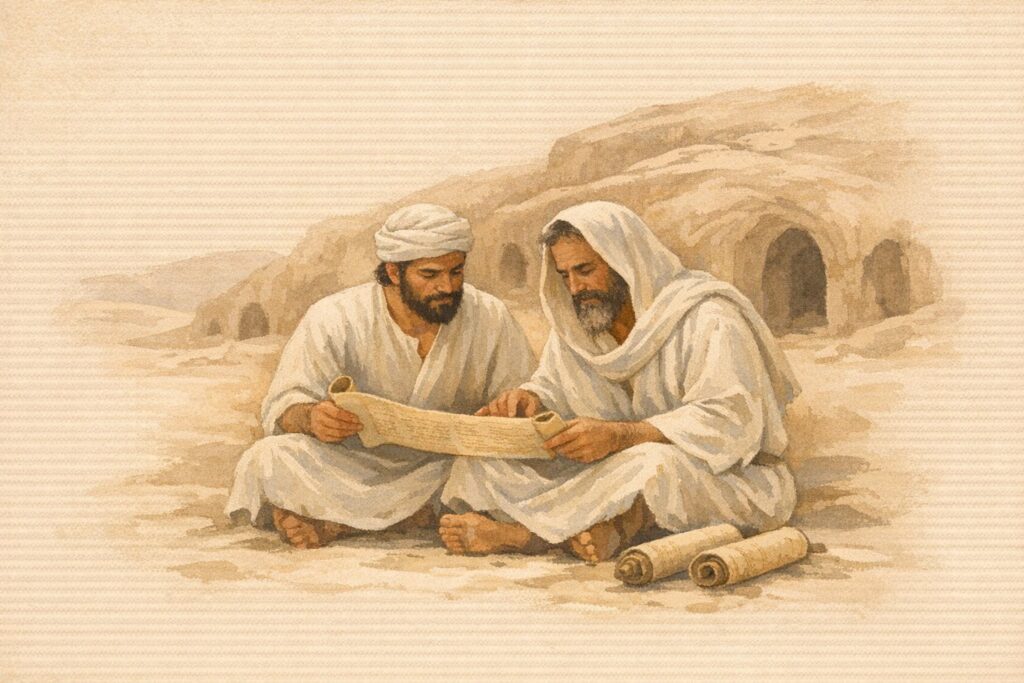
Josephus describes the Essenes as the third of the major Jewish sects, distinguished by their strict discipline and communal way of life.
“For there are three philosophical sects among the Jews. The followers of the first of which are the Pharisees; of the second, the Sadducees; and the third sect, which pretends to have a severer discipline, are called the Essenes. These last are Jews by birth, and seem to have a greater affection for one another than the other sects have. These Essenes reject pleasures as an evil, but esteem continence, and the conquest over our passions, to be a virtue. they neglect wedlock, but choose out other persons’ children, while they are pliable, and fit for learning, and esteem them to be of their kindred, and form them according to their own manners. They do not absolutely deny the fitness of marriage, and the succession of mankind thereby continued; but they guard against the lascivious behavior of women, and are persuaded that none of them preserve their fidelity to one man.”
The War of tHE jews ii:119-121
In The War of the Jews, Josephus provides one of the most detailed descriptions of the Essenes found in ancient Jewish literature. His account has become especially significant in light of the discovery of the Dead Sea Scrolls, which many scholars associate with a sectarian community living at Qumran.
The origin of the name “Essenes” is uncertain, though it likely reflects a Greek rendering of a Semitic term. Some scholars have suggested a connection to an Aramaic root related to righteousness or piety – possibly corresponding to the later Hebrew concept of חסידות (Hasidut), meaning piety.
A defining feature of the Essenes is their strong sense of communal identity and separation from wider society. Josephus notes variations within the group, including those who marry and those who adopt a celibate lifestyle.
Note: While no explicit prohibition against marriage appears in the Dead Sea Scrolls or other sources, no clear evidence of women has been found at Qumran. This absence extends to graves associated with the site, where the remains identified are overwhelmingly male. This has led many scholars to suggest that at least one Essene community practiced a form of celibate or male-dominated communal life, though the issue remains debated.
“These men are despisers of riches, and so very communicative as raises our admiration. Nor is there any one to be found among them who hath more than another; for it is a law among them, that those who come to them must let what they have be common to the whole order, insomuch that among them all there is no appearance of poverty, or excess of riches, but every one’s possessions are intermingled with every other’s possessions; and so there is, as it were, one patrimony among all the brethren. They think that oil is a defilement; and if any one of them be anointed without his own approbation, it is wiped off his body; for they think to be sweaty is a good thing, as they do also to be clothed in white garments. They also have stewards appointed to take care of their common affairs, who every one of them have no separate business for any, but what is for the uses of them all.”
The war of the jews ii:122-123
Two key characteristics stand out in Josephus’ description: their approach to marriage and their practice of shared wealth.
1. Marriage
Josephus presents the Essenes as exercising restraint in matters of marriage. While not all groups rejected marriage entirely, some adopted celibacy and placed a strong emphasis on self-discipline and purity.
Within the broader context of the Hellenistic-Roman world, where social and moral norms could differ significantly from traditional Jewish values, this emphasis on restraint makes a clear boundary. Their way of life reflects a deliberate distancing from wider cultural patterns and a focus on undivided commitment to their communal and religious ideals.
Note: In 1 Corinthians 7, Paul expresses that while he does not oppose marriage, he suggests that a married person’s attention is divided between devotion to God and responsibility to a spouse. For this reason, he recommends remaining unmarried where possible, not because marriage is deficient, but because it allows for a more undivided focus on religious life. A similar emphasis on undivided devotion may be observed in some Essene traditions, though any direct connection remains uncertain.
2. Shared Wealth
Josephus also highlights the Essenes’ communal approach to property. Members were required to relinquish personal ownership and contribute their resources to the group, resulting in a shared economic life.
In contrast to the wider Hellenistic-Roman world – where significant disparities between wealth and poverty were common – this practice represents a distinct social model. It reflects a commitment to equality within the community and the removal of economic distinctions among its members.
Note: Similar patterns of communal sharing appear later in early Christian sources (e.g. Acts 2), suggesting that such practices were already known within the Jewish world of the Second Temple period.
In contrast to both the Pharisees and the Sadducees, the Essenes can be understood as a more radical response to the challenges of the age. Rather than adapting tradition or preserving existing structures, they withdrew from broader society and formed tightly ordered communities centered on purity, discipline, and shared life.