Neder (Oath)
Soft Determinism and Hard Determinism
Soft determinism suggests that a person is responsible for their own fate, yet still has the possibility of influencing God’s decree through moral repentance and ethical action.
Hard determinism, by contrast, presents a more rigid view: a person has no real control over their destiny. In this framework, fate cannot be altered through ordinary means.
Within this tension, a final and extreme possibility appears: the Neder.
The Neder (Oath) as an Extreme Form of Petition
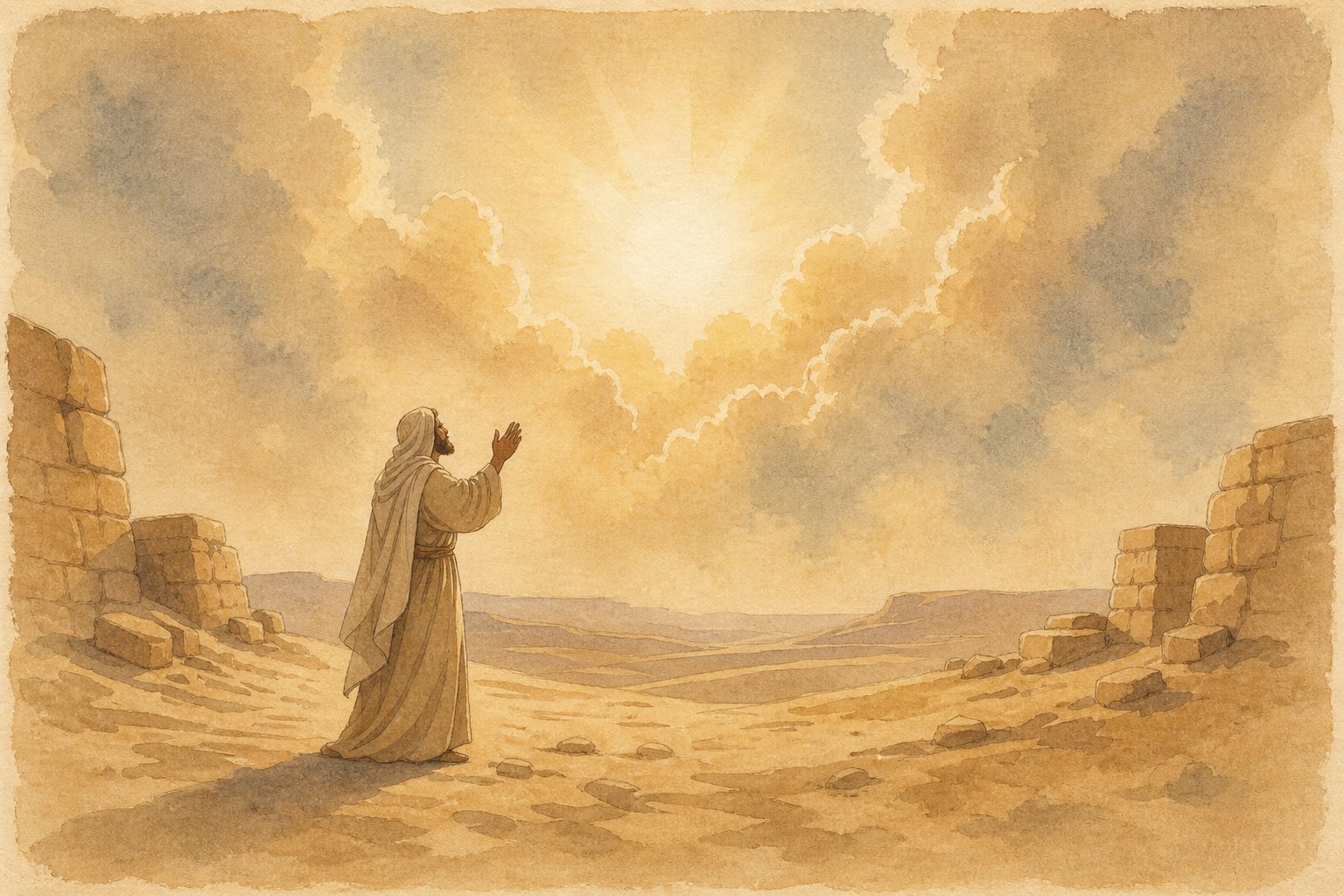
A Neder is a binding oath made before God – often in a moment of deep crisis or desperation.
It is not a casual prayer or request, but a total commitment: a transactional vow in which a person offers something of immense personal value in exchange for divine intervention.
In this understanding, the Neder functions as a kind of final escape mechanism when all other forms of agency feel exhausted.
The tradition also reflects deep ethical tension around vows that involve harm, particularly when they extend toward family or children. Such actions are consistently condemned in the Tanakh (Old Testament) as violations of God’s will.
Prohibition of Child Sacrifice in the Tanakh
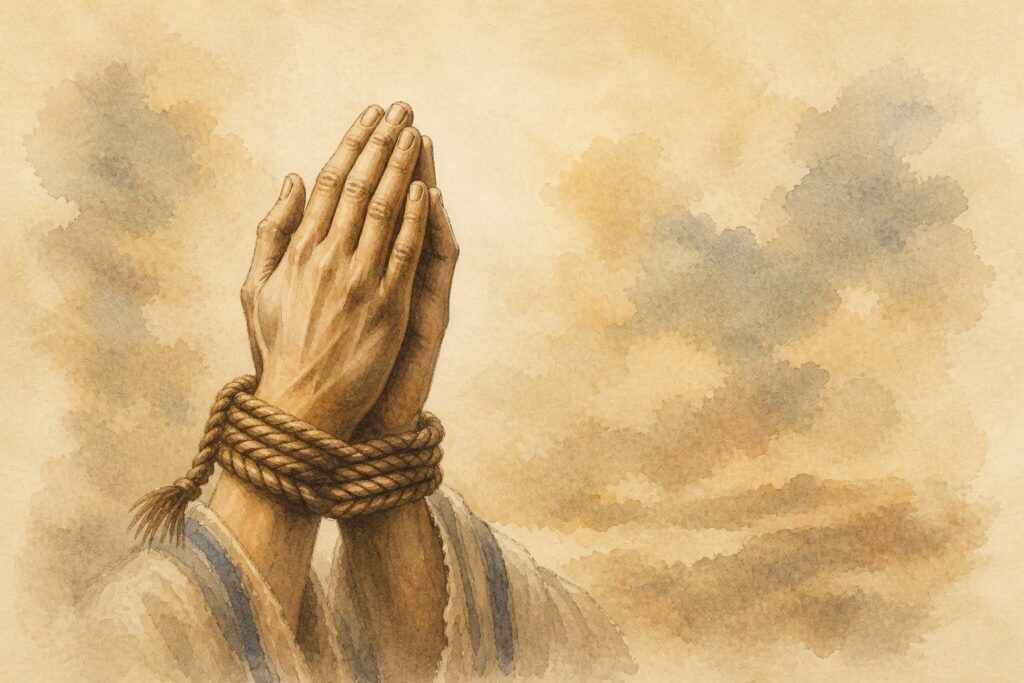
The Tanakh strongly rejects ritual practices involving child sacrifice, considering them an abomination associated with the practices of surrounding nations such as the Canaanites.
“…You must not worship the Lord your God in their way, because in worshiping their gods, they do all kinds of detestable things the Lord hates. They even burn their sons and daughters in the fire as sacrifices to their gods…”
Deuteronomy 12:31
“…The people of Judah have done evil in my eyes, declares the Lord. They have set up their detestable idols in the house that bears my Name and have defiled it. They have built the high places of Topeth in the Valley of Ben Hinnom to burn their sons and their daughters in the fire – something I did not command, nor did it enter my mind…”
Jeremiah 7:30-31
“…The Lord said to Moses, ‘Say to the Israelites: ‘Any Israelite or any foreigner residing in Israel who sacrifices any of his children to Molek is to be put to death. The members of the community are to stone him. I myself will set my face against him and will cut him off from his people; for by sacrificing his children to Molek, he has defiled my sanctuary and profaned my holy name. If the members of the community close their eyes when that man sacrifices one of his children to Molek and if they fail to put him to death, I myself will set my face against him and his family and will cut them off from their people together with all who follow him in prostituting themselves to Molek…'”
Leviticus 20:1-5
These passages establish a clear moral boundary: the destruction of children as part of a religious ritual is fundamentally forbidden.
Jephthah’s Oath (Judges 11-12)
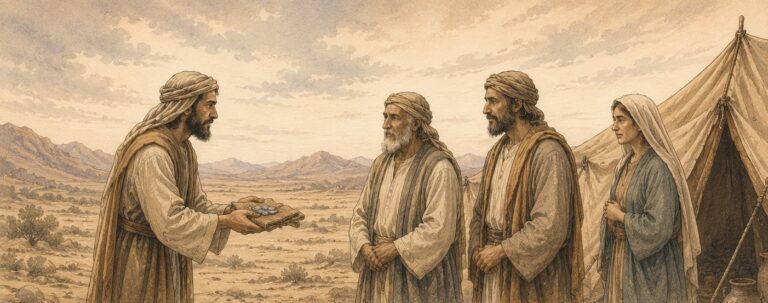
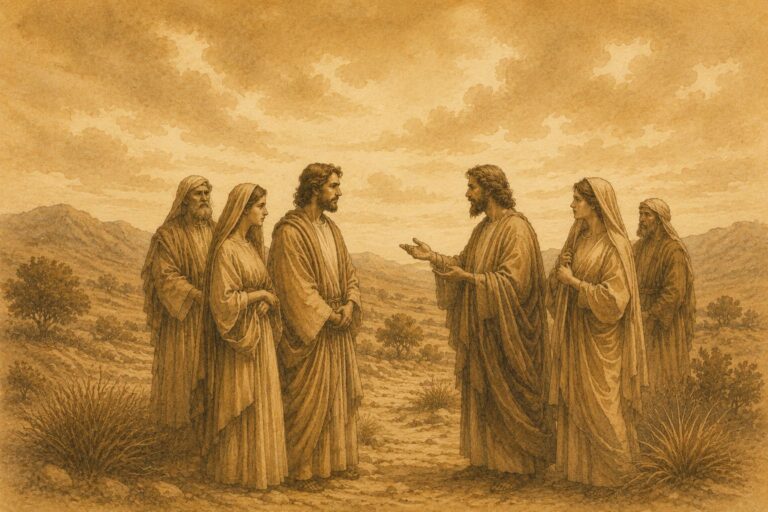
Jephthah was born in the region of Gilead, within the territory of the tribe of Manasseh. He was the son of a prostitute, and following the death of his father, he was driven out by his brothers and rejected by the elders of his community.
Cast out from his household and stripped of his status, Jephthah became associated with a group of outcasts living on the margins of society.
Later, when the Ammonites attacked Gilead, the very elders who had once supported his banishment called him back to lead them in battle. His return marks a dramatic reversal, from rejection to leadership.
In return for divine victory, he makes a vow:
“And Jephthah made a vow to the Lord: ‘If you give the Ammonites into my hands, whatever comes out of the door of my house to meet me when I return in triumph from the Ammonites will be the Lord’s, and I will sacrifice it as a burnt offering'”
Judges 11:30-31
The Lord granted Jephthah his victory, but the price he would have to pay would be terrible, for after his victory, it was his daughter who came to greet him on his return.
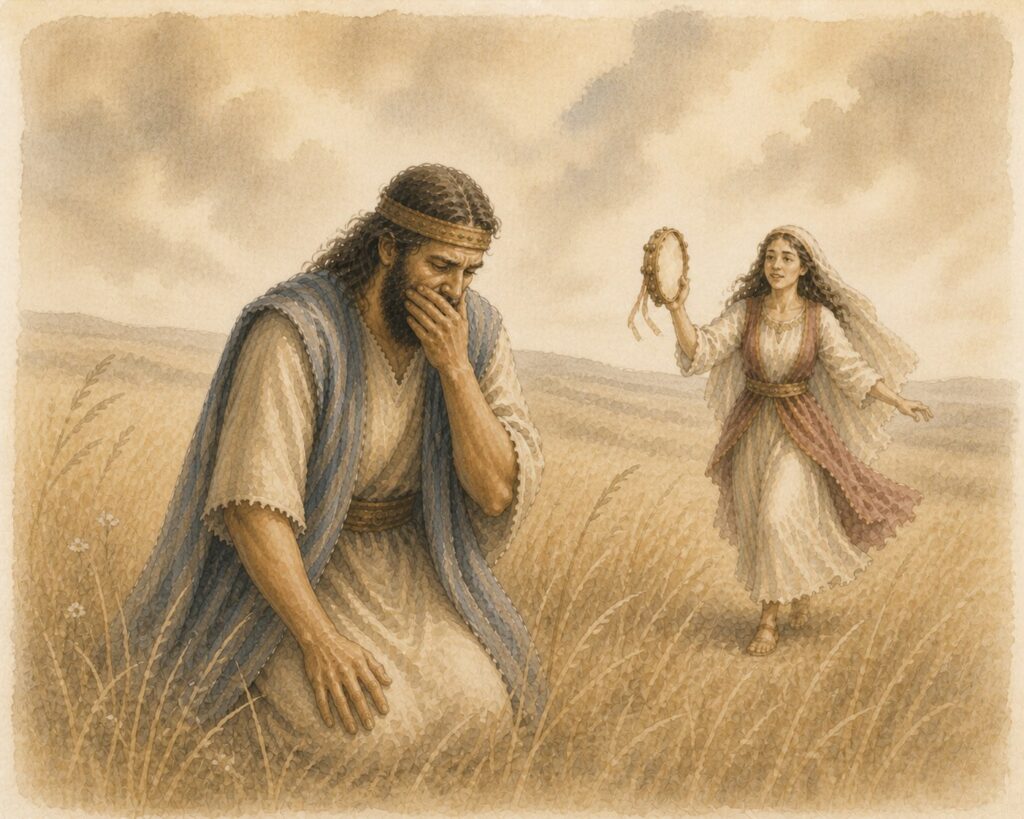
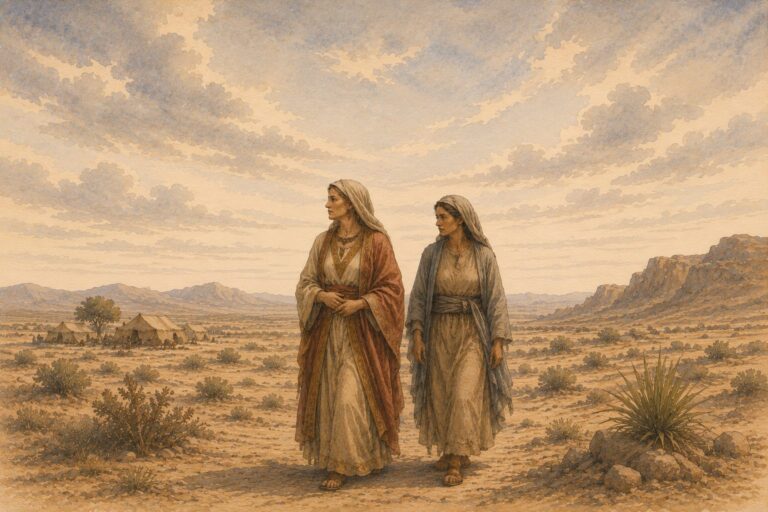
His daughter asked for two months to go to the mountains with her companions and mourn the life she would never have; a life without marriage or children. After this period, she returned to her father.
In many readings of the text, Jephthah then fulfills his vow. In doing so, he not only loses a daughter, but also his lineage, as she was his only child.
This moment represents a tragic fulfillment of an irreversible vow – one in which the consequences of speech and desperation collide with a devastating outcome.
Jephthah did not have a kingdom to save; in asking for God’s help, he had, in effect, asked to save himself – his status. He sought to rise from rejection to the highest position. This suggests that personal ambition may have played a role in leading him to this agreement.
Jephthah’s story can be understood as a movement from social collapse to sudden elevation, where the desire to secure restored status is bound up with an irreversible commitment. The emotional weight of the narrative reflects the danger of vows made under extreme psychological pressure.
Hannah’s Neder (1 Samuel)
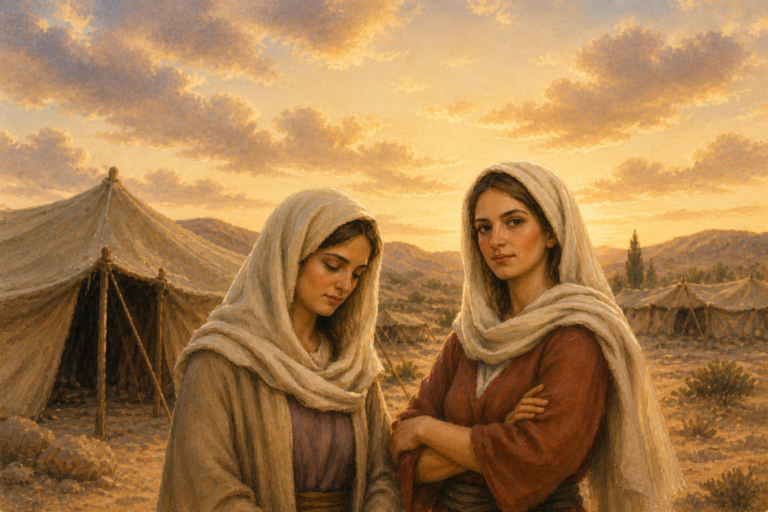
Hannah, the wife of Elkanah, lived in Ramathaim Zuphite, a small town north of Jerusalem.
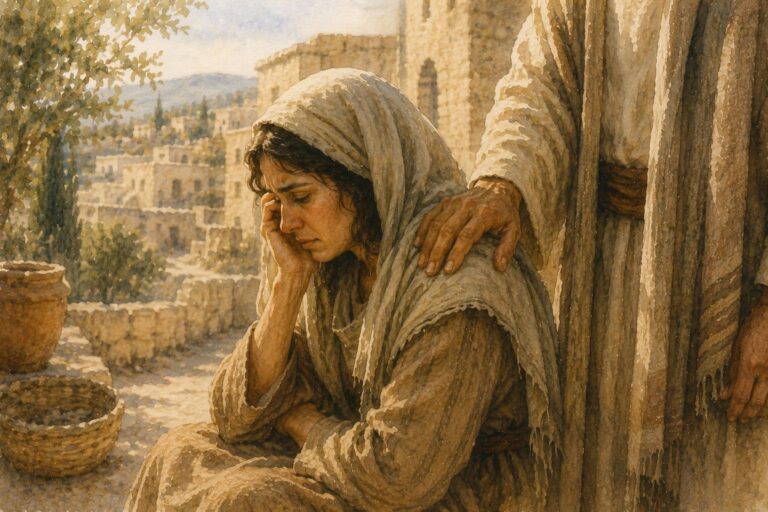
Although she had a loving husband, Hannah was barren, and her status within the household began to decline. Elkanah took a second wife, Peninah, who provoked Hannah and treated her harshly, deepening her distress.
In her anguish, Hannah went to the Tabernacle in Shiloh. There, she prayed to the God of Israel and made her Neder. The High Priest, Eli, observed her as she prayed, and, seeing the intensity of her silent anguish, mistook her for being drunk.
“In her deep anguish Hannah prayed to the Lord, weeping bitterly.”
1 Samuel 1:10
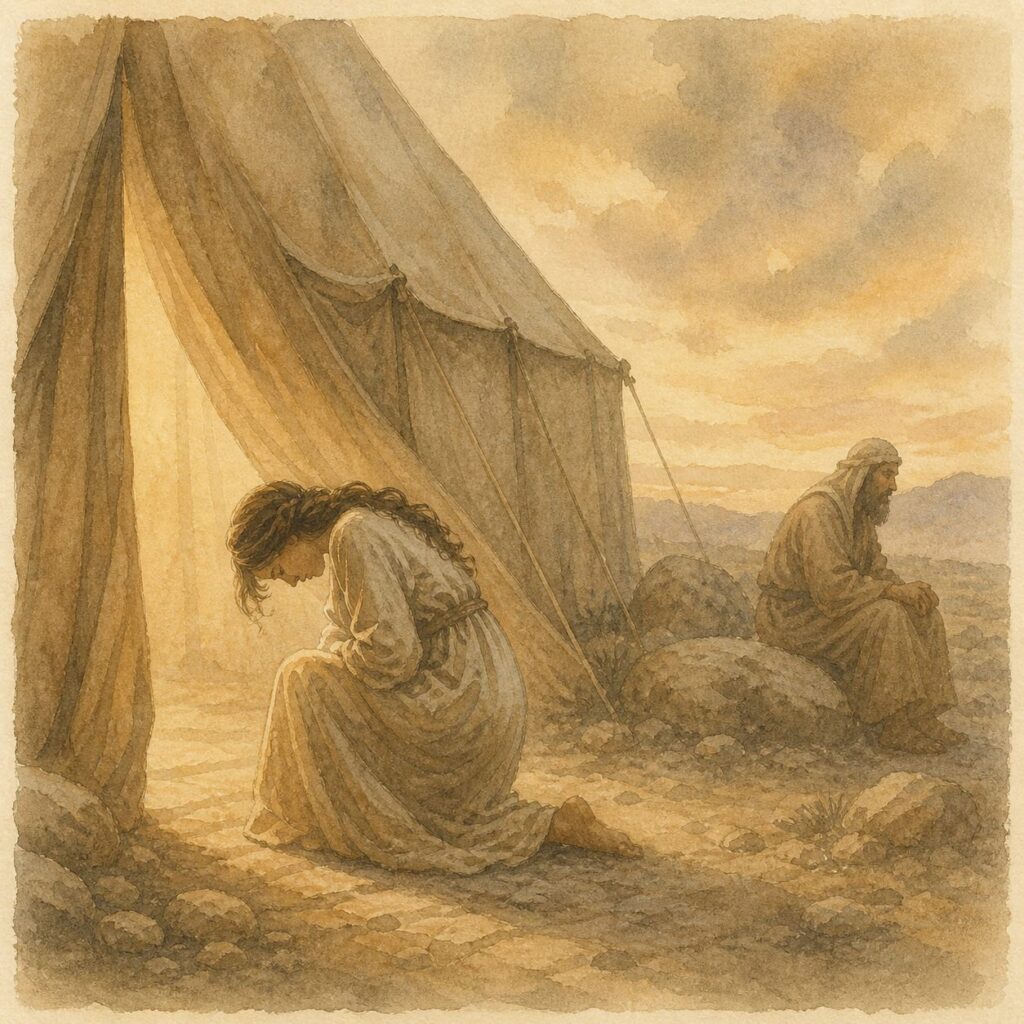
“As she kept on praying to the Lord, Eli observed her mouth. Hannah was praying in her heart, and her lips were moving but her voice was not heard. Eli thought she was drunk and said to her, ‘How long are you going to stay drunk? Put away your wine.'”
1 Samuel 1:12-14
Hannah made a vow that if she were granted a son, she would dedicate him entirely to the service of God.
“I prayed for this child, and the Lord has granted me what I asked of him. So now I give him to the Lord. For his whole life he will be given over to the Lord.”
1 Samuel 1:27-28
Elkanah was aware of Hannah’s Neder and did not oppose it after the child was born.
If the vow were not fulfilled, it would represent a breach of obligation with serious consequences for the child’s dedicated status.
After giving the Lord her firstborn child, Hannah then gave birth to three more sons and two daughters, and in this way, her position within her household and community was restored.
Every year she would return with her family during the time of the festivities to visit Samuel in Shiloh, where he remained in service.
In contrast to Jephthah’s vow, Hannah’s Neder results not in loss but in transformation. After the birth of Samuel, she dedicates him to the service of God, and later is blessed with additional children.
Her story reflects a different trajectory: one in which despair is not destructive, but becomes the catalyst for renewal.
Authority, Structure, and the Regulation of Vows (Numbers 30)
The Bible also introduces a legal framework for vows, particularly in relation to family authority structures.
A vow made by a woman while still in her father’s household may be upheld or annulled depending on his response. If he remains silent, the vow stands; if he intervenes, it may be cancelled.
“When a young woman still living in her father’s household makes a vow to the Lord or obligates herself by a pledge and her father hears about her vow or pledge but says nothing to her, then all her vows and every pledge by which she obligated herself will stand. But if her father forbids her when he hears about it, none of her vows or the pledges by which she obligated herself will stand; the Lord will release her be
Numbers 30:2-5
The same principle applies within marriage, where the husband assumes this role of authority.
“If she married after she makes a vow or after her lips utter a rash promise by which she obligates herself and her husband hears about it but says nothing to her, then her vows or the pledges by which she obligated herself will stand. But if her husband forbids her when he hears about it, he nullifies that vow that obligates her or the rash promise by which she obligates herself, and the Lord will release her.”
Numbers 30:6-8
In contrast, a man’s vow, once made, is presented as binding and cannot be annulled within this framework.
This structure introduces an important dimension: vows are not only spiritual acts, but socially embedded commitments shaped by authority and consent.
Historical Echoes: Kings and Crisis Vows
The Tanakh does not forbid the giving of an Oath (Neder), but it sees the cost of such vows as an abomination.
The Tanakh condemns two kings of the Kingdom of Judah, Ahaz and Manasseh, both of whom sacrificed their children.
Ahaz and Manasseh, kings of Judah in the 8th century BC, ruled during a time when the Assyrian Empire dominated the region. For 300 years, the Empire was the biggest and mightiest power in the ancient Middle East. Over the course of its expansion, Assyria conquered Aram, overtook the northern Kingdom of Israel, and exiled the Ten Tribes.
As vassal kings under Assyrian power (enslaved kings who paid taxes to the Assyrian Kingdom), Ahaz and Manasseh lived under constant political pressure. Their rule was marked by instability, fear, and the threat of total collapse.
In this context, both kings are described as engaging in practices associated with child sacrifice – acts condemned in the strongest terms in the Bible. In both cases, these actions are presented as condemned, rather than accepted.
Jeremiah saw Jerusalem besieged and observed the dire situation of the Jews as perhaps a punishment for their deeds. He also witnessed fathers hurting their sons, which he viewed as an abomination.
“They have built the high places of Topheth in the Valley of Ben Hinnom to burn their sons and daughters in the fire – something I did not command, nor did it enter my mind”
Jeremiah 7:31
Jeremiah returns to this condemnation repeatedly:
“They have built the high places of Baal to burn their children in the fire as offerings to Baal – something I did not command or mention, nor did it enter my mind.”
Jeremiah 19:5
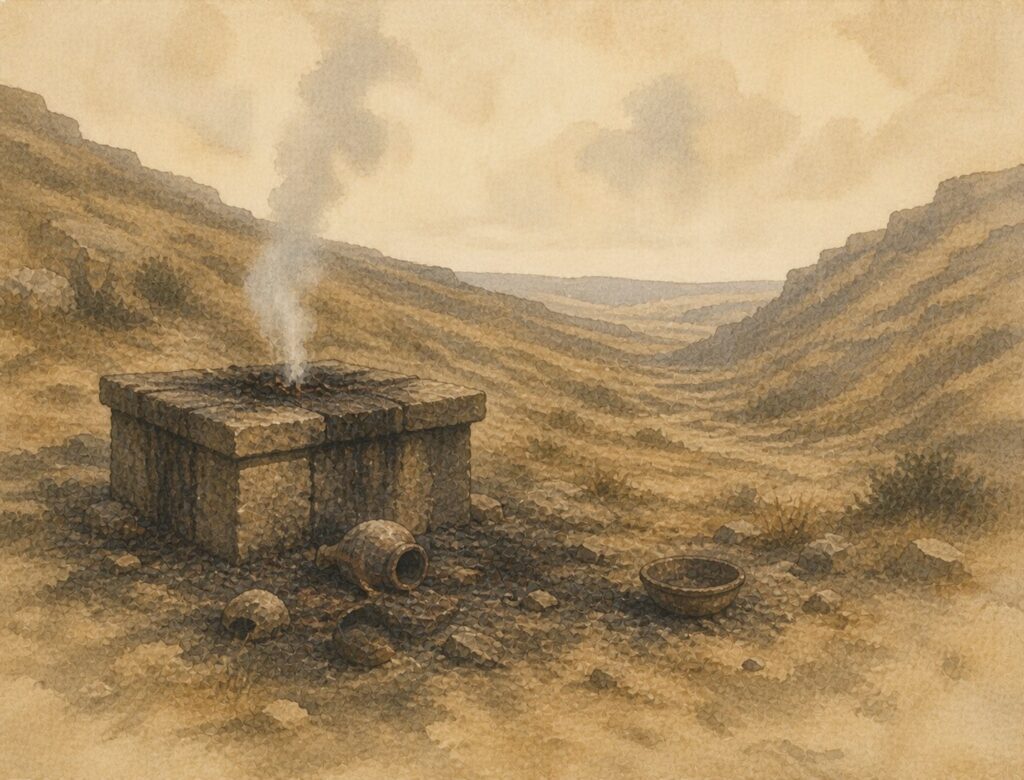
These actions can be understood as expressions of extreme desperation during ancient times: attempts to preserve power and secure survival at any cost.
A similar moment appears in the account of Mesha, King of Moab, after he rebelled against Joram, Son of Ahab, King of Israel.
After rebelling against Israel and facing near defeat by a coalition of Israel, Judah, and Edom, Mesha performs an extreme act at the height of crisis:
“Then he took his firstborn son, who was to succeed him as king, and offered him as a sacrifice on the city wall. The fury against Israel was great; they withdrew and returned to their own land.”
2 Kings 3:27
In this case, the act appears to alter the course of events, as the attacking forces withdraw.
Moab was spared. The Lord had answered King Mesha’s Neder.
These narratives reflect the extremity of crisis-driven decision-making, where kings, facing the collapse of their kingdoms, resort to acts that cross moral and theological boundaries.
Conclusion: The Neder and the Collapse of Agency
Across these narratives, the Neder emerges as a symbol of extreme human agency under pressure.
It appears at the edge of control, when ordinary moral, political, or personal strategies feel exhausted.
The Neder is not presented as a recommended path, but as an expression of existential collapse: a moment where a person attempts to negotiate with fate itself.
Sometimes it is associated with transformation and renewal. At other times it leads to irreversible loss.
In all cases, it reveals the profound tension between human desire, moral boundary, and perceived divine order.