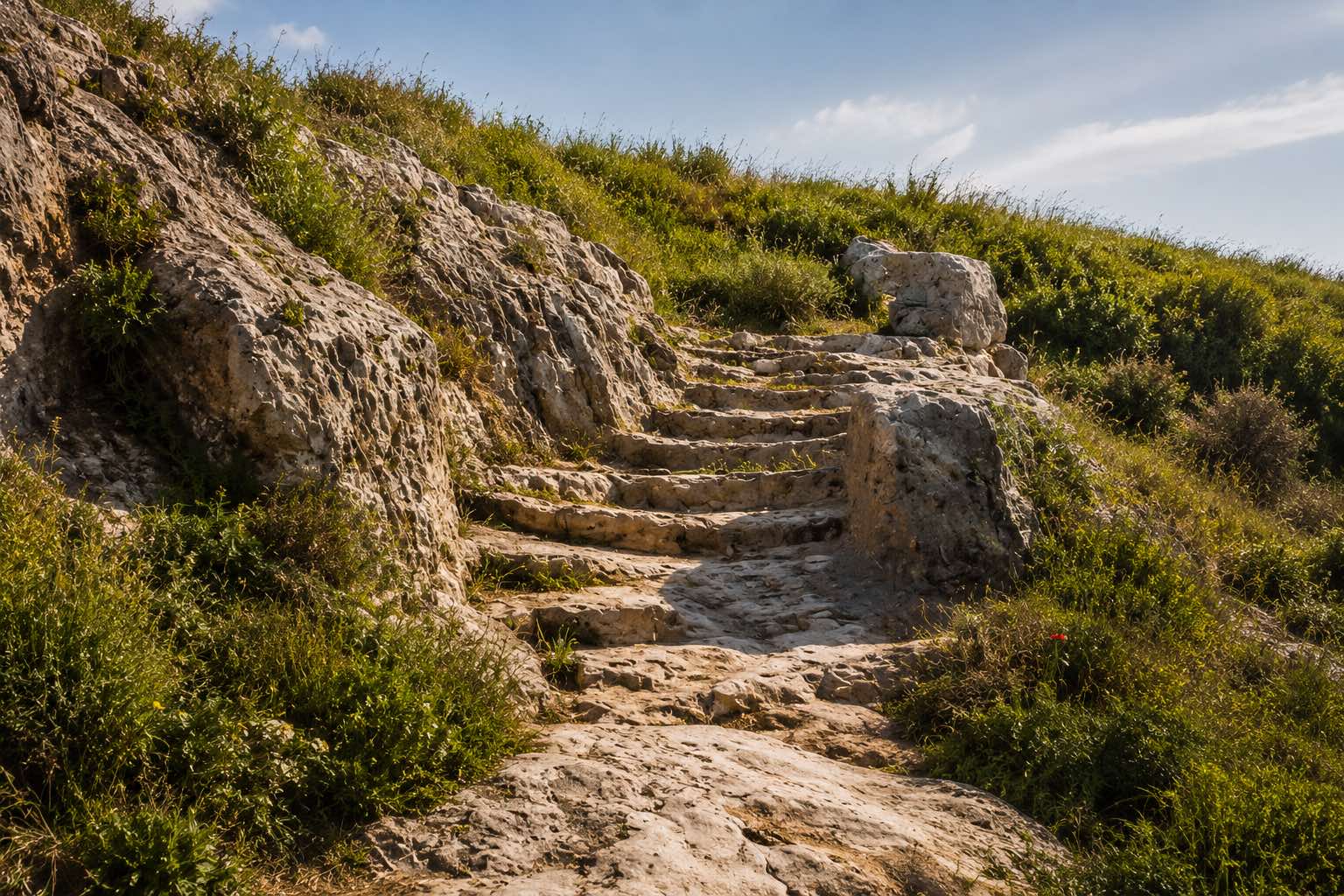
The Ascents (Steps)
Throughout the Land of Israel, archaeologists have discovered a unique phenomenon along ancient roadways – gradual ascents carved into stone along the paths.
These ascent paths were usually narrow, often no wider than 6 feet, and are found along traditional routes that led pilgrims towards Jerusalem during the Second Temple period.
They serve as testimony to the network of roads and pathways used by the descendants of Abraham, Isaac, and Jacob, who dwelled throughout the land and journeyed towards the Temple in Jerusalem.
In many places, these carved ascents followed older transit routes that had already been used for generations by travellers and pilgrims making their way towards the holy city.
Later, the Romans paved many of these same routes as part of their imperial road system. Yet in certain areas, the earlier ascent paths can still be identified alongside or beneath the later Roman roads.
The phenomenon of these gradual ascents, discovered throughout the Land of Israel, has led researchers to associate them closely with the pilgrimage routes of the Second Temple period.
In some locations, however, the practical necessity of these carved steps is not always fully understood. Their physical features and placement do not always appear essential for travel alone. This has led some to suggest that the ascents may have held not only a practical function, but also a symbolic or spiritual meaning for the pilgrims who walked them.
Perhaps these gradual ascents expressed more than a physical journey towards Jerusalem.

They may also have reflected a deeper religious idea – the human desire to ascend towards higher spiritual ground and draw closer to God.