Priestly Watches in the Temple
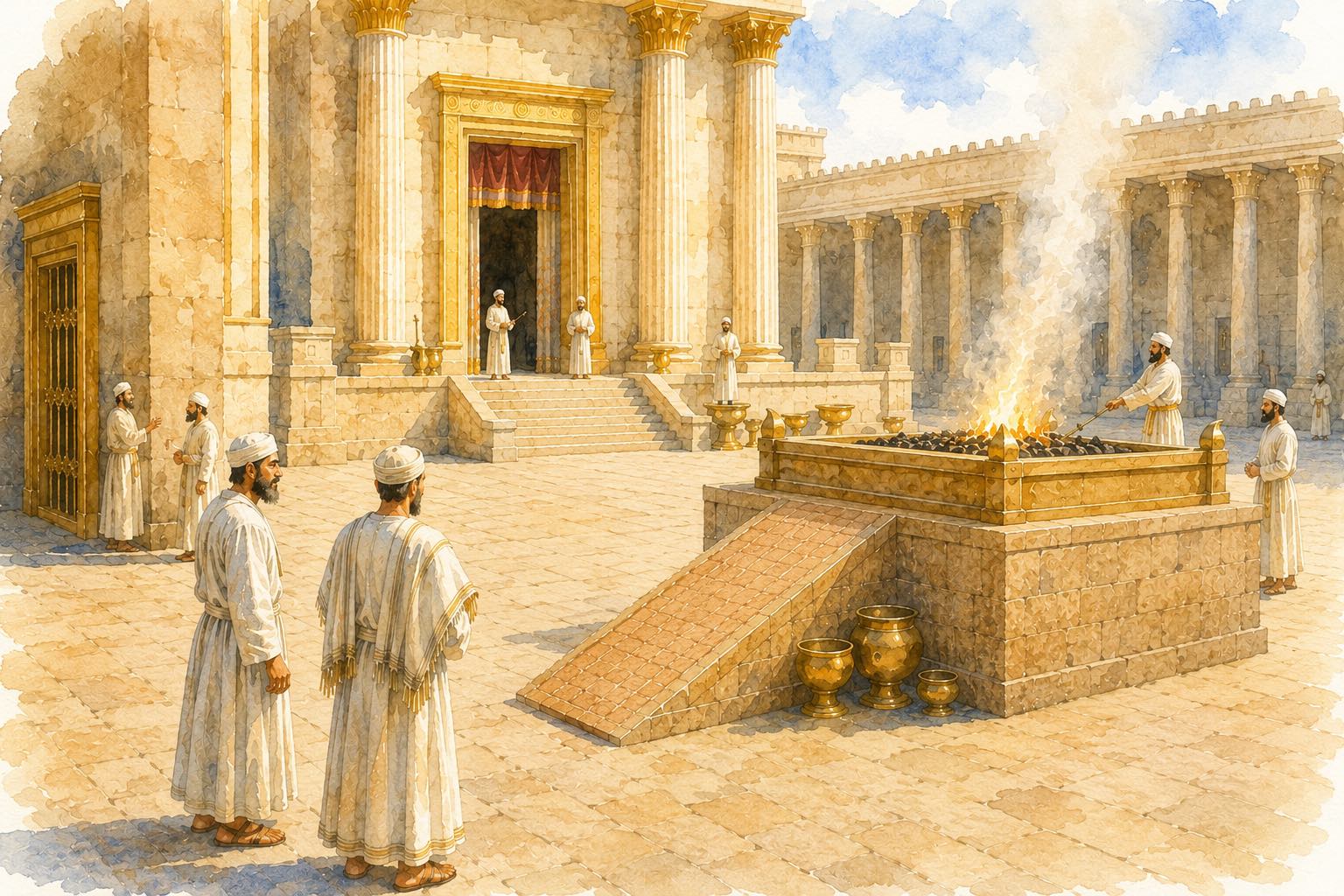
There was much work to be done in the Temple in Jerusalem. The service in the Temple was considered the Lord’s work, and those who carried it out were the priests, who acted as representatives of the people of Israel before God.
Their duties included the offering of sacrifices, lighting the Menorah and other lamps, guarding the Temple, participating in prayer services, teaching the Torah alongside the Sanhedrin, which was located within the Temple complex, and much more.
The Temple attracted large numbers of worshippers every day. During the pilgrimage festivals, the Temple courts became especially crowded, and the priests were responsible for ensuring that everything was carried out in proper order.
In the Letter of Aristeas, a Jewish work written during the second century BC, we are given a glimpse into the life and work of the priests in the Second Temple:
“The priestly work there is none more exalted than theirs in quickness, and also its beauty and silence. They rarely do all work out of desire and great effort and each one takes care of what has been assigned to him. They work non-stop, those with the wood, and those with the oil, and those with the semolina flour and those with the perfumes, and others raising sacrifice of meat and they do this with great might…
And those that are in charge of this choose beasts without blemish the most wonderful and excellent in their fat and after they will do as mentioned above…
For relaxation, a place was appointed for them where those who rested gathered. And in that time, some that rested would wake up quickly, even if the inspector was not around. Although the servants of the Temple were around seven hundred and those bringing sacrifice were many, everything was done in God-fearingness as required for great divinity.”
The Priests’ Daily Work in the Temple
Morning Service
The daily duties began before dawn and included:
A. Removal of the ashes
The ashes of the burnt offering were removed according to the commandment in Leviticus 6:10-11
“And the priest shall put on his linen garment, and his linen breeches shall he put upon his flesh, and take up the ashes which the fire hath consumed with the burnt offering on the altar, and he shall put them beside the altar. And he shall put off his garments, and put on other garments, and carry forth the ashes without the camp unto a clean place.”
Leviticus 6:10-11
B. Arrangement of three fire systems on the altar
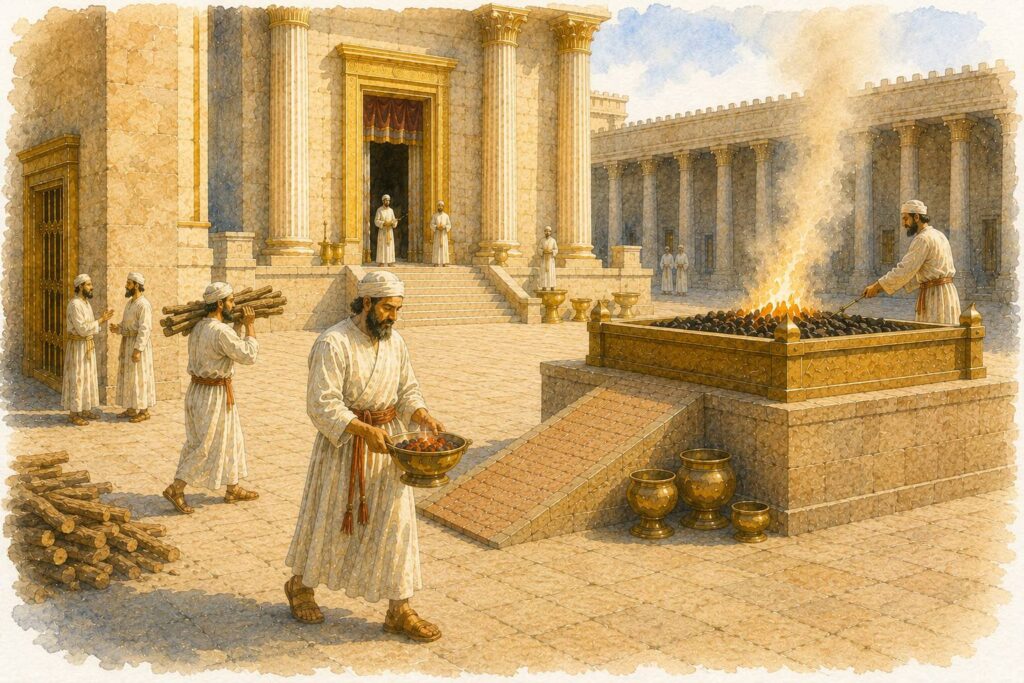
Three separate fires were arranged every morning on the Altar of Burnt Offering:
- The Great Fire
- Upon this fire all the daily sacrifices were burned.
- The Second Fire
- From this fire glowing embers were taken and carried to the Golden Altar of Incense within the Temple.
- The Sustaining Fire
- This fire existed solely to fulfil the commandment:
“Fire shall be kept burning upon the altar continually; it shall not go out.”
Leviticus 6:13
It was not used for sacrifices or incense but ensured that the altar fire never went out.
C. The Daily Morning Offering
Thirteen priests were required for this service.
D. Preparation of the Menorah and the Altar of Incense
E. Recitation of the Shema and the Blessings
“Hear, O Israel: The Lord our God, the Lord is One.”
Deuteronomy 6:4
F. Sacrifices and Libations
The offering of libations was an inseparable part of the sacrificial service in the Temple. These included wine, oil, and fine flour offered alongside various sacrifices.
Evening Service
The evening duties included:
- The daily evening offering.
- Burning of incense.
- Sacrifices and libations.
- Lighting of the Menorah.
- Locking the Temple gates and securing the Temple complex.
- Guard duty throughout the night.
The Need for Priestly Watches
The priests did not receive a tribal inheritance in the Land of Israel like the other tribes. Their livelihood came from tithes, offerings, and portions of the sacrifices given to them according to the Torah.
Because of the vast amount of work required in the Temple, a system was needed to organise the priesthood efficiently. This system became known as the Priestly Watches.
According to rabbinic tradition, there were originally eight priestly divisions: four descended from Eleazar and four from Ithamar. Later, King David and Samuel the Prophet expanded these into twenty-four divisions (Babylonian Talmud, Taanit 27a).
As the population of Israel grew and increasing numbers of pilgrims travelled to Jerusalem, the priesthood expanded as well. The twenty-four priestly watches allowed the different priestly families to participate in the continual work of the Temple.
By the late Second Temple period, the priesthood had grown considerably. A single priestly watch could contain many priestly families, and not every priest served at the same time. Duties were distributed among the various households within each watch, allowing large numbers of priests to participate in the Temple service in an orderly manner.
The names of these divisions are recorded in 1 Chronicles 24:7-18:
- Jehoiarib
- Jedaiah
- Harim
- Seorim
- Malchijah
- Mijamin
- Hakkoz
- Abijah
- Jeshua
- Shecaniah
- Eliashib
- Jakim
- Huppah
- Jeshebeab
- Bilgah
- Immer
- Hezir
- Happizzez
- Pethahiah
- Jehezkel
- Jachin
- Gamul
- Delaiah
- Maaziah
Each priestly division came to Jerusalem twice a year. Each period of service lasted one week, from Sabbath to Sabbath. Most priests did not live permanently in Jerusalem. They lived throughout the Land of Israel and travelled to the city only during their appointed week of service. This allowed the priestly families from across the country to participate in the work of the Temple while still maintaining their homes and communities elsewhere.
During the three pilgrimage festivals – Passover, Shavuot, and Sukkot – all twenty-four divisions came to Jerusalem and participated together in the Temple service. During these festivals, Jerusalem was filled with pilgrims from across the Land of Israel and from Jewish communities throughout the Roman world. The large number of sacrifices and worshippers required the participation of all twenty-four priestly divisions.
The duties of each watch included:
- Offering public and private sacrifices.
- Removing ashes from the altar.
- Preparing wood for the altar fires.
- Lighting the Menorah.
- Burning incense.
- Various other Temple responsibilities.
Certain Temple duties were assigned by lot. Some tasks were considered especially honourable, particularly the offering of incense upon the Golden Altar. According to rabbinic tradition, a priest would normally be permitted to offer the incense only once in his lifetime, making it a highly desired privilege.
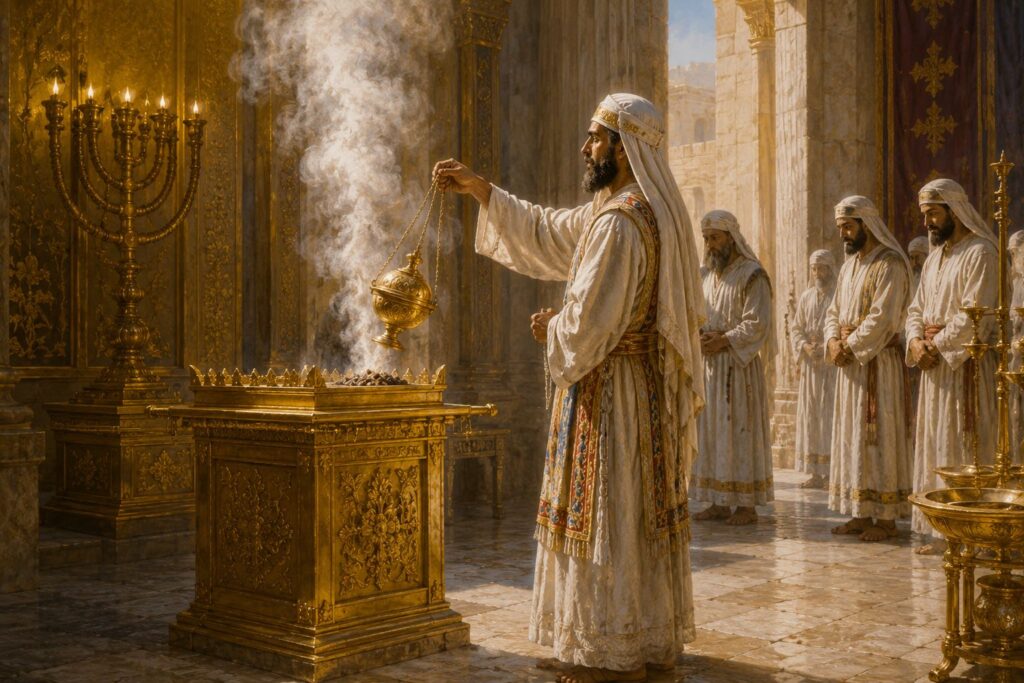
The priestly watch system is also mentioned in the New Testament. Luke records that Zechariah, the father of John the Baptist, belonged to the division of Abijah and was serving in the Temple when the angel Gabriel appeared to him.
Luke also records that Zechariah was chosen by lot to enter the Temple and burn incense:
“So it was, that while he was serving as priest before God in the order of his division, according to the custom of the priesthood, his lot fell to burn incense when he went into the Temple of the Lord.”
Luke 1:8-9
This brief account provides a fascinating glimpse into the priestly watch system and the way Temple duties were assigned during the Second Temple period.
The priests received portions of certain sacrifices and other priestly gifts as their means of support. Through these provisions they maintained themselves, and some priestly families became quite wealthy.
The Changing of the Watches
The transition between priestly watches took place each Sabbath.
When the incoming watch arrived and the outgoing watch departed, they met at the Temple and exchanged blessings. The priestly watches were joined by Levites, who assisted with duties such as music, singing, guarding, and various practical tasks within the Temple, together with representatives from the communities of Israel.
The Talmud records the blessing exchanged between the departing and arriving divisions:
“May He who caused His name to dwell in this house cause love and brotherhood, peace and camaraderie to dwell among you.”
Babylonian talmud, Berakhot 12a
Each priestly watch was led by a senior priest who supervised the work of the division.
The watches were further divided into family groups, known as priestly households. Each household had its own leader, who oversaw the priests serving under him and ensured that every task was carried out properly.
Some duties within the Temple were permanent assignments. Great care was taken to ensure that priests and Levites remained in their designated roles so that the Temple service would be conducted properly and according to tradition.
The Priestly Watch on the Day of the Destruction
The Jerusalem Talmud records:
“Rabbi Yose says: The day of the destruction of the Temple was after the Sabbath, at the end of the Sabbatical year, during the watch of Jehoiarib, on the ninth of Av.”
Jerusalem Talmud, Taanit 4:5
The sages had much criticism regarding the conduct of the priesthood and the spiritual condition of the nation before the destruction of the Second Temple. Therefore, they also preserved the name of the priestly watch serving at the time of the destruction. Perhaps they saw significance in the fact that the watch of Jehoiarib was on duty when the Temple fell.
The Priestly Watches After the Destruction
The Mishnah and Talmud contain many references to the priestly watches and the functioning of the Temple before its destruction. Yet after the destruction of the Temple in AD 70, we hear far less about them.
Before the destruction, the priests stood at the centre of Jewish worship and leadership. The people encountered them regularly, and they held a highly respected position in society. With the destruction of the Temple, however, their role changed dramatically.
Historical and archeological sources indicate that many priestly families relocated to the Galilee, settling in places such as Tzippori, Meron, and other Jewish communities.
At the same time, we begin hearing much more about the Sanhedrin and the rabbinic leadership that emerged after the destruction.
So what happened to the priestly watches?
An inscription discovered in a synagogue in Caesarea, dating to the Byzantine period, records the names of some of the priestly watches and the locations where they settled after leaving Jerusalem.

Another inscription discovered in Yemen preserves the names of eleven priestly watches and the locations to which they migrated. Together with the Caesarea inscription, it helps us reconstruct the movement of priestly families into the Galilee following the destruction of the Second Temple and later the migration of the Jewish communities after the Bar Kokhba Revolt.
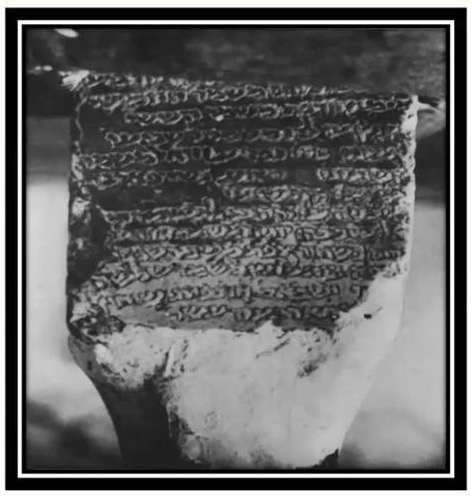
These inscriptions provide a remarkable reminder that although the Temple was destroyed, the memory of its priestly watches continued to be preserved for centuries. Through them, Jewish communities remembered the families who once served in the Temple and maintained a connection to Jerusalem and its sacred past.
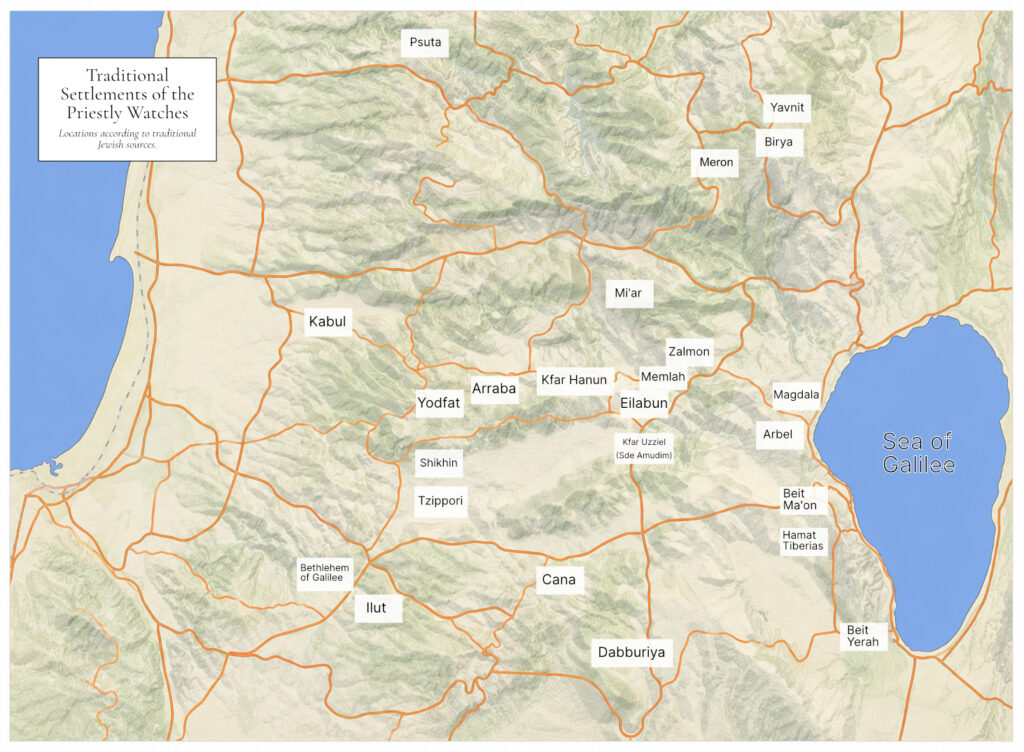
Following the destruction of the Second Temple, Jewish tradition preserved the memory of the priestly watches by associating them with communities throughout the Galilee. The map above illustrates these traditional settlements as recorded in the Caesarea and Yemen inscriptions and other Jewish sources.